Validate and Repair JSON Online: A Practical Guide
Trailing commas, single quotes, Excel exports: diagnose and fix broken JSON before it reaches production.
Why invalid JSON causes silent failures
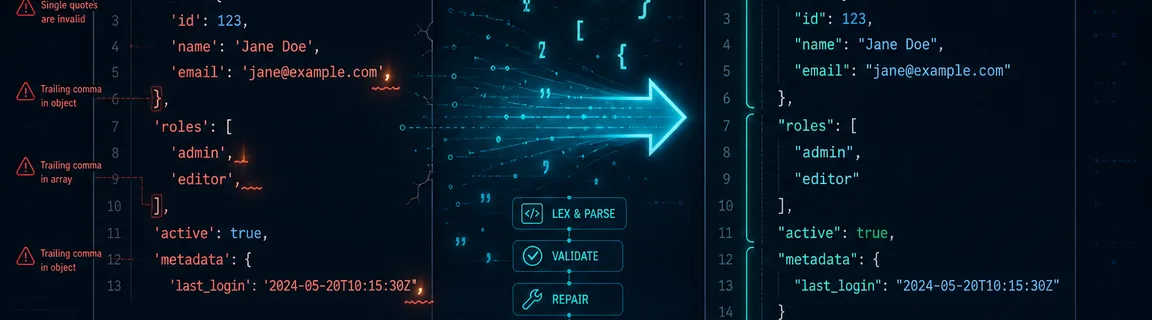
JSON is the backbone of modern APIs, configuration files and data exchange. But a single trailing comma, unquoted key or wrong quotation mark can break an entire pipeline — silently in production logs, loudly in customer-facing dashboards. The online JSON validator checks syntax with precise error locations so you spot the problem instantly. When validation fails but the payload is salvageable, the JSON repair tool fixes common issues automatically — trailing commas, single quotes, missing commas between elements — all processed locally in the browser on the online JSON tools hub. If you need context for what happens after a payload is valid and compact, see our REST API optimization guide.
Impact on your workflow and pipeline
A typical failure scenario — the JSON fixture ships with a trailing comma, the CI test passes (loose parser locally), but the production Go server rejects it on startup.
Before optimization
- File size
- —
- Load time
- Late — CI or deploy
After optimization
- File size
- —
- Load time
- Early — before commit
Improvements
JSON repair is not magic. It handles common, well-defined patterns — trailing commas, single quotes, unquoted keys, missing commas between elements. Structural breaks go beyond automatic repair.
Improvements
Best practices and limitations
The validator is the first gate — use it on any JSON you author, copy-paste from external sources, or receive from third-party APIs. Treat repair as insurance for common mistakes, not a substitute for correct output at the source.
The json-repair tool handles well-defined patterns — it is not a general-purpose AI parser. When the structure is irrecoverably broken, you need to trace back to the source.
Common JSON errors and what causes them
JSON does not allow a comma after the last element in an array or object. JavaScript developers write it all the time (parsers often tolerate it), but strict JSON parsers — Java, Python, Go — reject the file outright.
JSON requires double quotes (\u0022) around all strings and keys. JavaScript allows single quotes, but a payload that works in `eval()` will be rejected by any RFC 8259-compliant parser.
JavaScript objects accept bare identifiers as keys, but JSON requires every key to be a double-quoted string. A common mistake when hand-writing fixtures or migrating JS config files.
Real-world JSON often arrives corrupted by copy-paste artifacts: Windows line endings mixed with Unix ones, invisible control characters, truncated lines, or HTML entities. The validator catches these at the byte level.
Using FastMinify: validate, then repair
The most reliable approach is always: validate first, repair second (only if needed), minify third. The online JSON validator gives detailed error locations; the JSON repair tool fixes what it can automatically.
Step 1: Paste and validate
Drop your JSON into the validator. If valid — green check, you're done. If invalid — precise line/column and error message appear immediately.
Step 2: Run repair (if needed)
If the error looks like trailing commas or single quotes, paste the same payload into the repair tool. It runs locally and returns corrected JSON plus a `changed: true/false` flag.
Step 3: Validate again + minify
Re-run validation on the repaired output to confirm it parses cleanly. Then minify the JSON for deployment — compact format saves bandwidth before compression.
The two tools fit naturally into a broader debug workflow with other utilities on the JSON tools hub.
Conclusion
A JSON syntax error rarely announces itself politely. It fails at 2 AM in a CI run, crashes an API on startup or silently corrupts a downstream integration. Validate your payloads early with the FastMinify online validator — it pinpoints the exact failing character. When the mistake is common (trailing comma, single quote), repair fixes it automatically. Re-validate, minify for production, and ship with confidence.
Related Articles

Skip SSH and nginx for a side-project Next.js app. Compare Railway, Render, Vercel and a VPS, then ship from Git after minifying assets in the browser.

Encode or decode text, a file, or an image as Base64 in the browser — data URIs, email attachments, JWT segments. 100% local, not encryption.

Compile SCSS or LESS snippets (variables, nesting, mixins) to CSS in the browser without npm run build — for reviews, snippets, or a machine without Node.