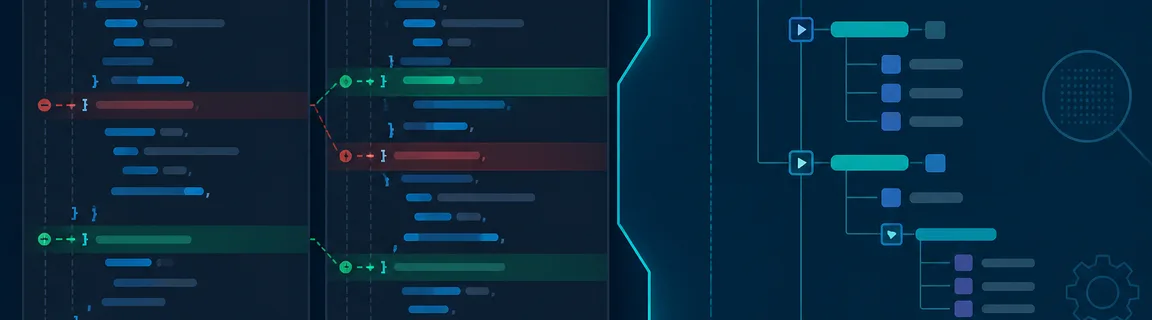
JSON Formatter, Diff and Tree Viewer: Compare and Explore Payloads
Format, diff two API responses and explore deep JSON in a tree — a no-install debug workflow in your browser.
Three complementary tools for JSON debugging
Once syntax is valid, the real work begins: reading a minified payload, spotting what changed between two API versions, or navigating a deeply nested config with thousands of lines. The online JSON formatter makes a compact document readable in one click — 2 or 4 space indentation, tabs, without altering data. JSON diff compares two documents side by side and lists modified, added or removed paths. The JSON tree viewer collapses deep branches, highlights search results and avoids scrolling endless lines. These three tools on the JSON tools hub run entirely in the browser — no server upload. If JSON is invalid, start with the validate and repair JSON guide before formatting or comparing.
Best practices and honest limits
Formatting or comparing invalid JSON produces frustrating errors. Follow the order: validate (and repair if needed) → format or explore → diff → minify for prod.
Each tool has a precise scope — do not expect a full IDE or automatic merge.
Formatter, diff and tree: when to use each tool
The JSON formatter parses input, verifies it is valid, then rewrites the document with consistent indentation. Numbers, key order and strings stay identical — only whitespace changes.
JSON diff requires two valid documents. It flags modified values, added or removed keys and type changes — with JSON Pointer paths to locate each delta.
The JSON tree viewer builds an interactive tree after successful parse. Depth ≥ 2 collapsed by default on large docs; search on keys and string values; expand all / collapse all for very deep payloads.
When your JSON contains multiline strings, quotes or sequences copied from devtools, the JSON escape tool (Escape and Unescape tabs) prepares or restores literals via native JSON.stringify / JSON.parse — before formatting or exploring.
Debug workflow: format, explore, compare
You copy a 200 response from Network devtools — a single line of several KB.
Step 1: Validate (if unsure)
Paste into the JSON validator. Syntax error? See the repair guide before continuing.
Step 2: Format
Open the JSON formatter, pick 2 or 4 spaces, click Format. The document becomes readable without changing data.
Step 3: Explore in tree (optional)
For a deeply nested object, paste the same output into the JSON tree viewer — collapse useless branches and search for a specific key.
Two config or API response snapshots must be compared before deployment.
Step 1: Normalize (optional)
Format both documents with the same indentation style — or enable key sorting on the formatter for stabler diffs.
Step 2: Compare
Paste original on the left and new version on the right in JSON diff. The table lists each modified path.
Step 3: Drill into the delta
Suspicious path? Copy the branch into the tree viewer or reformat only that section for team review.
These tools fit into a broader pipeline on the JSON tools hub.
Conclusion
Debugging JSON should not require installing an extension or uploading sensitive payloads to a third-party server. Format to read, explore in a tree to navigate, compare to validate regressions — all locally on FastMinify. Chain validation and minification when you are ready to ship.
Related Articles

Skip SSH and nginx for a side-project Next.js app. Compare Railway, Render, Vercel and a VPS, then ship from Git after minifying assets in the browser.

Encode or decode text, a file, or an image as Base64 in the browser — data URIs, email attachments, JWT segments. 100% local, not encryption.

Compile SCSS or LESS snippets (variables, nesting, mixins) to CSS in the browser without npm run build — for reviews, snippets, or a machine without Node.